

Flush Inset Doors VS Overlay Doors - The Quiet Craft Behind Clean Lines
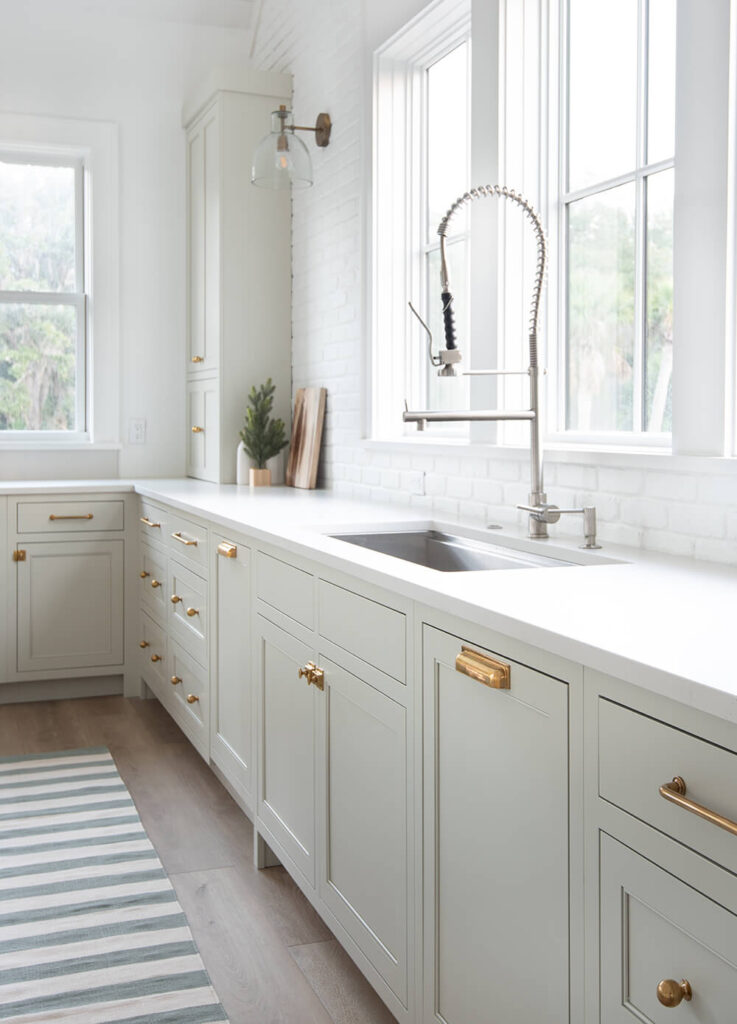
An inset door sits flush inside its frame instead of on top of it, so the door face and the frame face share one flat plane. That single decision gives a cabinet or wall niche its clean, super high-end look. It is also one of the hardest details in woodworking to get right.
Inset doors are showing up in more American kitchens, baths and built-ins every year. Here is where the style comes from, why it looks so good.
 |
Inset vs. overlay: where the door sits
Most cabinets in American homes use overlay doors. The door closes against the front of the cabinet and covers part or all of the frame behind it. Overlay is forgiving: if the box is slightly out of square, the door hides it.
An inset door closes into the opening. The door, the frame and the surrounding wall or cabinet face all land on the same plane. A thin, even gap, called the reveal, outlines the door on all four sides. That reveal is the whole design. When it is even, the piece looks like furniture. When it is not, everyone notices. Our reveals are slightly smaller than typical.
The European influence
The flush, quiet look many people now want owes a lot to European design. After World War II, European cabinetmakers moved away from heavy face frames toward simple boxes built from flat panels. As one history puts it, "After World War II, simplification and efficiency was pursued to help speed reconstruction" (Wikipedia, 32 mm system). That frameless method is still often called "European cabinetry" in North America (Wikipedia, frameless construction).
To be precise, most European frameless cabinets use full-overlay doors, not true inset. What Europe gave American design was the attitude: one uninterrupted plane, minimal hardware, nothing that does not need to be there. Classic inset construction is older, rooted in English and early American furniture, Shaker pieces among them. Today's best inset work blends the two: the old craft of a door set into its frame, with the European commitment to a flat, calm surface.
Why American designers are choosing inset
Inset was once a niche reserved for high-end custom homes. Now it is showing up on designers' trend lists. In Domino's survey of 18 designers on 2026 cabinet styles, Sarah Randolph of Randolph Interior Design predicted that "the inset door with a beveled edge will be especially popular in 2026," and Claire O'Connor of O'Connor Estates pointed to "refined inset or slim Shaker styles that balance minimalism with craftsmanship" (Domino).
Lauren Saab of Saab Studios Design described inset fronts with integrated pulls this way: "The look is tailored and architectural, blending craftsmanship with modernism" (Apartment Therapy). The wider move is toward storage that disappears into the room. Kristina Khersonsky of Studio Keeta says, "In 2026, we'll continue to see a strong shift toward seamless, integrated storage solutions" (Homes & Gardens).
That phrase, minimalism with craftsmanship, explains the appeal. Inset reads as modern and handmade at the same time.
The sleekness: why flush looks so good
A flush door removes the shadow line and the stepped edge that overlay doors create. The eye reads one surface instead of a box with a lid on it. Three things make that happen:
- One plane. Door and frame sit level, so light falls evenly across the whole face.
- A crisp reveal. A consistent hairline gap frames the door like a mat frames a print.
- Less visual noise. With the frame visible and the door tucked inside it, hardware can be minimal or hidden entirely.
The result feels built into the wall rather than hung on it. That is exactly what you want from a niche or a built-in.
The hard part: fabrication
The same flush face that makes inset beautiful also makes it unforgiving. As one cabinet manufacturer puts it, "Since the doors sit perfectly flush inside the frame, there is zero room for error," and "small installation errors become much more noticeable than they would with overlay cabinets" (ROC Cabinetry).
Here is what has to go right:
- A square opening. Experienced builders on WoodWeb aim to keep frames within 1/64" of square (WoodWeb). Overlay hides that error. Inset shows it.
- A tight, even reveal. Common gaps run about 5/64" to 3/32", roughly 2 to 2.5 mm, with painted doors needing a little extra room for finish build-up (WoodWeb). We go even tighter than this as standard.
- Room for wood movement. Solid wood swells in humid summers and shrinks in dry winters. One builder on WoodWeb sets gaps at 5/64" in summer and 3/32" in winter to stay even year-round.
- Precise hinges. Inset hinges have to be mounted so the door closes dead flush, with no lip and no rub.
- Hand fitting. Many inset doors are made slightly oversize and planed down to their opening, one at a time.
All of that takes time. One cabinetmaker warns, "Inset doors take up a lot more time than other cabinetry," and says inset work is often underbid (WoodWeb). That is why inset "typically cost[s] more because [it] require[s] greater manufacturing precision and installation accuracy" (ROC Cabinetry).
Inset in wall niches
Wall niches are a natural fit for the inset idea. A niche already sits inside the wall, so the goal is the same: a frameless finish that sits flush with the surface around it and an opening that looks like it was always meant to be there. The feel makes a small space feel deliberate instead of added on.
The same rules apply on a smaller scale. The frame has to be square, the joints tight, and the wood chosen and finished to handle a home or office's moisture swings. At Hammer and Nail Studios, that is the standard we hold every handcrafted piece to.
The bottom line
Inset is a quiet detail that takes a lot of work. It pairs the European instinct for clean, uninterrupted surfaces with an older tradition of hand-fitted furniture. Done well, nobody notices the effort, only that the piece looks right. If you want that look in your kitchen, bath, living-room, entryway, get in touch and let's talk about your space.
Sources
- Domino: We Asked 18 Designers: What Kitchen Cabinet Style Will Rule in 2026?
- Apartment Therapy: Kitchen features ahead of 2026 trends
- Homes & Gardens: Kitchen cabinet trends 2026
- ROC Cabinetry: Everything dealers should know about inset kitchen cabinets
- WoodWeb: Inset cabinet door fitting and tolerances
- Wikipedia: 32 mm cabinetmaking system
- Wikipedia: Frameless construction